CNit Model Overview
What is CNit?
CNit (Carbon-Nitrogen Interactions in Terrestrial ecosystems) is a process-based terrestrial biogeochemistry model that simulates the coupled dynamics of carbon and nitrogen cycles. It is designed as the land component of MAGICC (Model for the Assessment of Greenhouse Gas Induced Climate Change), providing a computationally efficient representation of terrestrial carbon-nitrogen feedbacks for integrated assessment and climate projection studies.
CNit answers questions about terrestrial biogeochemistry in the climate system:
How does nitrogen availability limit carbon uptake by ecosystems?
How do land use changes affect terrestrial carbon and nitrogen pools?
What are the feedbacks between carbon and nitrogen cycles under climate change?
How do CO₂ fertilization and warming interact with nitrogen limitation?
What is the carbon sequestration potential of afforestation scenarios?
Conceptual Framework
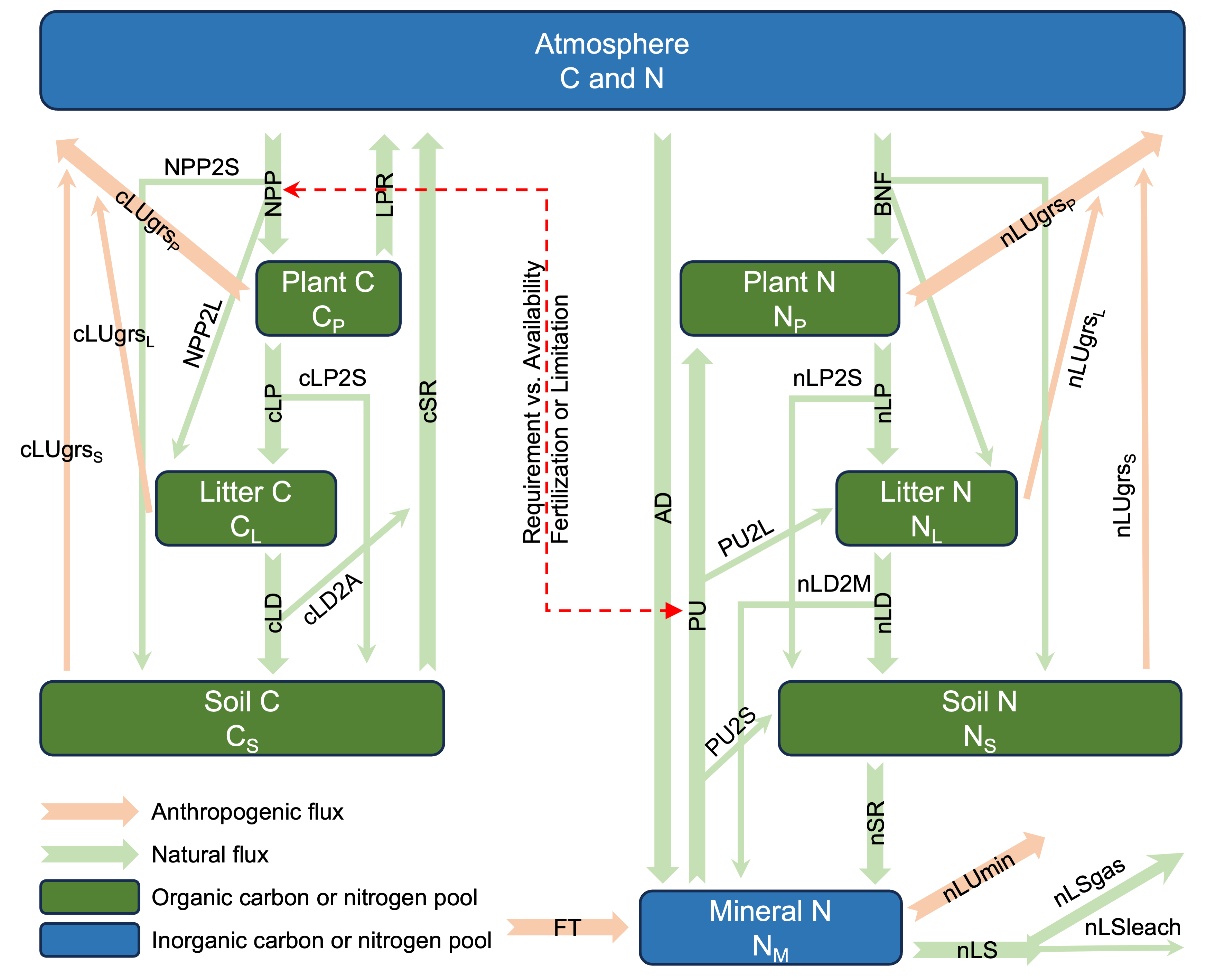
CNit represents the terrestrial biosphere as interacting carbon and nitrogen pools connected by process-based fluxes. The model tracks both elements through their coupled cycles, with explicit representation of nitrogen constraints on carbon uptake.
The model operates on annual timesteps, while capturing sub-annual processes through empirically-derived allocation fractions that represent rapid cycling within each year.
Model Structure
Carbon Pools (3)
- Plant Carbon Pool (CplsP)
Living plant biomass including leaves, wood, and roots.
- Litter Carbon Pool (CplsL)
Dead plant material undergoing decomposition.
- Soil Carbon Pool (CplsS)
Soil organic matter.
Nitrogen Pools (4)
- Plant Nitrogen Pool (NplsP)
Organic nitrogen in living plant biomass.
- Litter Nitrogen Pool (NplsL)
Organic nitrogen in dead plant material.
- Soil Nitrogen Pool (NplsS)
Organic nitrogen in soil organic matter.
- Mineral Nitrogen Pool (NplsM)
Inorganic nitrogen (NH₄⁺, NO₃⁻).
Key Processes
Carbon Processes
- Net Primary Production (NPP)
Carbon fixation by plants through photosynthesis. Modified by:
CO₂ fertilization effect
Temperature effect
Nitrogen effect
Land use effect
- Litter Production Respiration (LPR)
Heterotrophic respiration associated with plant tissue fast turnover within one year.
- Carbon Turnover
Litter production (cLP): Plant → Litter transfer
Litter decomposition (cLD): Litter → Soil transfer and respiration
Soil respiration (cSR): Soil organic matter decomposition
- Land Use Change
Deforestation (cLUdfst): Carbon loss from land clearing
Afforestation (cLUafst): Carbon gain from reforestation
Regrowth (cLUrgr): Natural recovery after deforestation
Nitrogen Processes
- Plant Nitrogen Uptake (PU)
Transfer of mineral nitrogen from soil to plants, driven by plant demand.
- Biological Nitrogen Fixation (BNF)
Conversion of atmospheric N₂ to organic nitrogen by microorganisms.
- External Inputs
Atmospheric deposition (AD): Wet and dry deposition
Fertilizer application (FT): Anthropogenic nitrogen addition
- Nitrogen Turnover
Litter production (nLP): Plant → Litter transfer
Litter decomposition (nLD): Litter → Soil transfer and mineralization
Soil respiration (nSR): Soil organic nitrogen turnover and mineralization
Mineral losses (nLS): Gaseous emissions and leaching
- Land Use Change
Organic nitrogen losses (nLUgrs): From deforestation
Mineral nitrogen losses (nLUmin): Direct emissions during land conversion
Carbon-Nitrogen Coupling
The key feature of CNit is bidirectional coupling between C and N cycles:
- Nitrogen Limitation of Carbon Uptake
Nitrogen availability constrains NPP. The model calculates nitrogen deficit:
\[PUdef = PUreq - PUavail\]where PUreq is based on potential NPP and stoichiometric requirements, and PUavail comes from mineralization and external inputs. This deficit applies an exponential limitation effect on actual NPP.
- Carbon-Driven Nitrogen Demand
Carbon uptake drives nitrogen demand through fixed C: N ratios. Higher NPP increases nitrogen uptake requirements and can stimulate biological nitrogen fixation.
Key Model Features
Annual Timestep with Allocation Fractions
The model uses annual timesteps for computational efficiency. Sub-annual processes are represented through allocation fractions that capture carbon and nitrogen cascading through multiple pools within one year (e.g., carbon fixed by plants that enters litter through turnover and then enters soil through decomposition within the same year).
Explicit Deforestation-Afforestation Separation
CNit separates gross land use emissions into:
Deforestation (LUdfst): Always positive, carbon loss
Afforestation (LUafst): Always positive, carbon gain
Regrowth (LUrgr): Natural recovery following deforestation
Afforestation decay (LUafst_decay): Gradual carbon loss from afforested areas
This separation is critical for carbon dioxide removal (CDR) scenarios where afforestation plays a major role.
Nitrogen Deficit Feedback
CNit explicitly calculates nitrogen deficit (PUdef = PUreq - PUavail), which:
Creates nitrogen limitation on NPP (positive deficit reduces NPP)
Can enhance NPP when surplus exists (negative deficit)
Drives compensatory biological nitrogen fixation
Affects decomposition rates through C-N coupling
Flux-Based Nitrogen Availability
Because mineral nitrogen has very fast turnover (days to weeks) compared to the annual timestep, nitrogen availability is parameterized as a flux rather than a pool size. Net mineralization is calculated from organic matter decomposition and provides an estimate of plant-available nitrogen from internal sources.
Two-Stage Nitrogen Solution
The nitrogen cycle is solved in two stages:
Organic nitrogen pools (plant, litter, soil)
Mineral nitrogen pool using net mineralization from stage 1
This approach reflects the coupling between organic matter decomposition and mineral nitrogen availability.
Environmental Effects
All process rates are modified by dimensionless effect factors:
- CO₂ Effect
Exponential enhancement of NPP with atmospheric CO₂ concentration.
- Temperature Effects
Temperature modifiers for NPP, respiration, decomposition, plant uptake, biological fixation, and mineral nitrogen losses.
- Nitrogen Effects
Exponential limitation of carbon processes (NPP, decomposition) based on nitrogen deficit.
- Land Use Effects
Modifications to process rates based on cumulative deforestation and afforestation history, blending equilibrium and instantaneous perspectives to capture transient dynamics.
When to Use CNit
CNit is Designed For:
✅ Global-scale simulations - Parameterized for global terrestrial biosphere
✅ Century-timescale projections - Annual timesteps suitable for multi-century simulations
✅ Integrated assessment modeling - Computational efficiency enables large ensemble studies
✅ Climate-carbon cycle feedbacks - Explicit CO₂, temperature, and C-N coupling
✅ Land use change scenarios - Explicit deforestation/afforestation for CDR analysis
✅ Carbon budget analysis - Mass-conserving structure for carbon accounting
Use Caution When:
⚠️ Individual site simulations - Not parameterized for site-specific characteristics
⚠️ Sub-annual dynamics needed - Annual timestep cannot resolve seasonal cycles
⚠️ Spatial heterogeneity critical - Pools are well-mixed, no spatial structure
⚠️ Extreme events matter - Fires, storms, pests not explicitly represented
⚠️ Other nutrients limit - Only carbon and nitrogen are modeled
Model Assumptions
Key assumptions in CNit:
Well-mixed pools - No spatial heterogeneity or depth structure within pools. All carbon and nitrogen in each pool is assumed to be uniformly mixed at the global scale.
Annual timestep - Sub-annual dynamics (seasonal cycles, daily variations) are not resolved. Rapid within-year processes are represented through allocation fractions that capture cascading through multiple pools within one year.
First-order kinetics with environmental modifiers - All turnover processes follow:
\[Flux = \frac{Pool\ Size}{\tau} \times \prod Environmental\ Effects\]where τ is the baseline turnover time and environmental effects are multiplicative modifiers (temperature, nitrogen, land use).
Constant baseline turnover times - Turnover times (τ) are fixed parameters that do not vary with environmental conditions or ecosystem state. Environmental responses are captured through effect modifiers rather than dynamically changing turnover times.
Prescribed land use emissions - Land use change is represented through prescribed emission fluxes (deforestation, afforestation, regrowth) provided as model inputs rather than computed from explicit simulation of land cover transitions, area changes, and ecosystem carbon/nitrogen densities.
Fixed stoichiometric parameters - Carbon-to-nitrogen ratios for plant uptake requirements (C:N ratios) are fixed parameters rather than dynamically varying with environmental conditions. However, through carbon-nitrogen coupling, the model allows for emergent variability in ecosystem C:N ratios as nitrogen availability constrains carbon uptake and decomposition rates vary with substrate stoichiometry.
No explicit vegetation types - All vegetation is represented as a generic “plant” pool without differentiation of forests, grasslands, croplands, or plant functional types.
Implicit microbial processes - Decomposition occurs through parameterized first-order turnover rates rather than explicit representation of microbial biomass, enzyme dynamics, or microbial community composition.
Next Steps
- Understand the Science:
See the API documentation at CNit Physics API for detailed equations and scientific descriptions in the docstrings. For complete theoretical background and validation, see the published papers listed in the References section below.
- Start Using CNit:
Continue to Quickstart Guide to install CNit and run your first simulation.
- Browse Examples:
See Example for common use cases and analysis workflows.
References
CNit Model Description:
Tang, G., Nicholls, Z., Norton, A., Zaehle, S., and Meinshausen, M.: Synthesizing global carbon–nitrogen coupling effects – the MAGICC coupled carbon–nitrogen cycle model v1.0, Geosci. Model Dev., 18, 2193–2230, https://doi.org/10.5194/gmd-18-2193-2025, 2025.
Tang, G., Zaehle, S., Nicholls, Z., Norton, A., Ziehn, T., & Meinshausen, M. (2026). Understanding the drivers of carbon–nitrogen cycle variability in CMIP6 ESMs with MAGICC CNit v2.0: Model and calibration updates. Journal of Advances in Modeling Earth Systems, 18, e2025MS005270. https://doi.org/10.1029/2025MS005270